
South 6th Avenue reopens to vehicle traffic
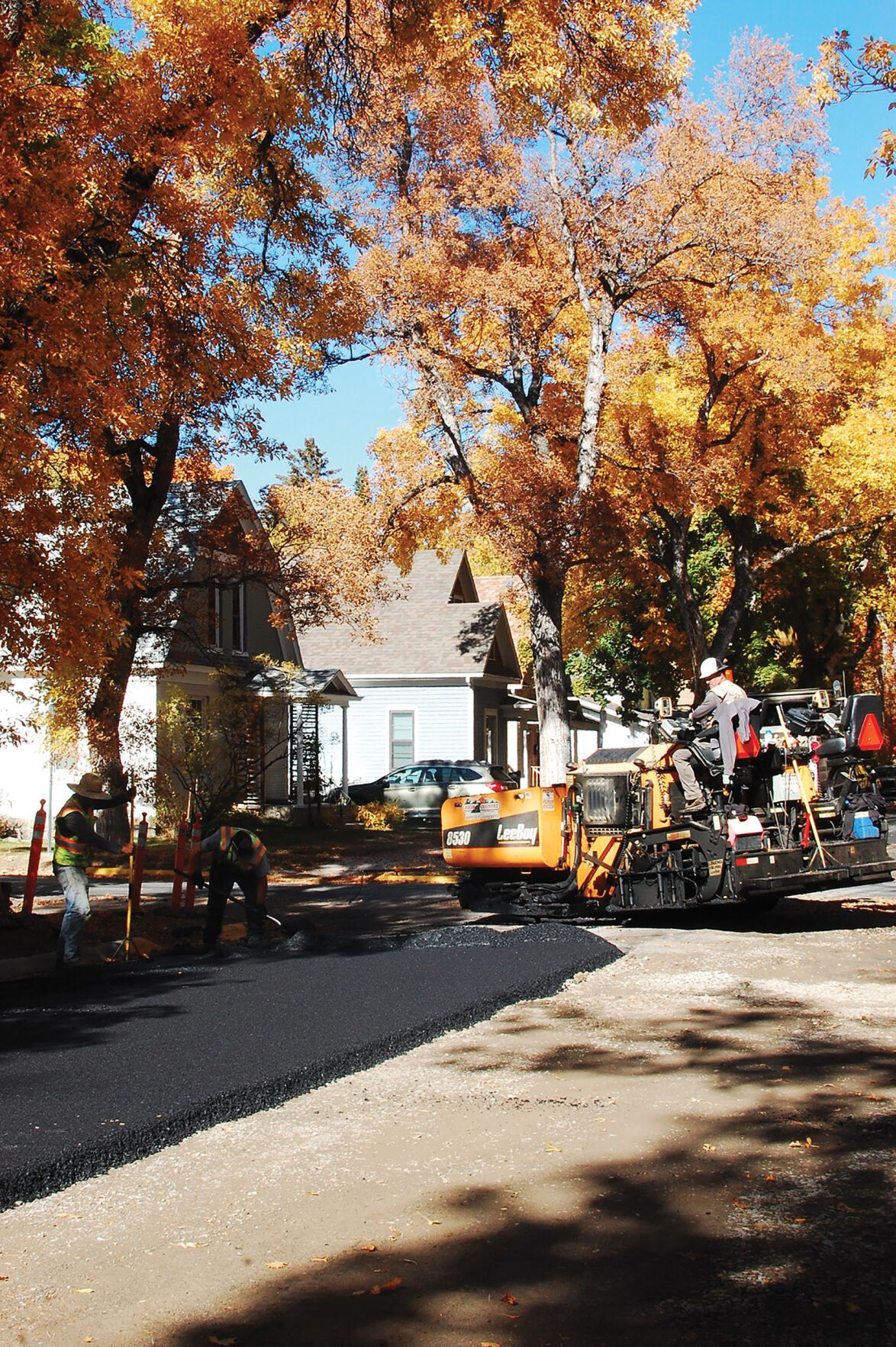
A bombardment of fall leaves christened the newly reconstructed South 6th Avenue as it reopened to vehicle traffic on Wednesday, Oct. 19 — for now. The road, which runs along the east side of Cooper Park, has been closed for reconstruction since June.
“We replaced the water main, sewer main, storm drain and rebuilt the street from curb to curb,” said Kellen Gamradt, the City of Bozeman engineer who designed the project. “The work completed this summer was the section from Babcock through Story street.”
South 6th Ave’s streets were identified as being amongst “the worst shape in the whole city” by a 2021 pavement condition study.
Gamradt also cited the centennial status of the utilities as justification for the project. “If we have a 100-year-old utility under the street, we’re not going to want to put a brand-new street over the top of that,” Gamradt said.
Although significant progress was made this year, the project has been fraught with delays since going out to bid in 2021, said Gamradt. The reconstruction was originally supposed to be completed last summer, however, Omdahl Excavation and Utilities delayed work until 2022, citing difficulties procuring materials.
The delays continued into 2022. Gamradt issued a stop-work order on Tuesday, Oct. 18, putting the project in a state of winter shutdown, but work is far from complete.
When work resumes next spring, Omdahl will face an uphill battle, having five blocks to go with only 30 days left on his contract. To make matters worse, Omdahl said, contract drawings show the stretch from Story to Cleveland is far more complex, with steep grades and a more complicated storm drain design.
“I’m optimistic that it’s going to go faster,” Gamradt said. “We have a good relationship with this contractor, and they’ve done a number of successful projects for us in the past.”
However, Gamradt was firm that this year’s delays will be the last. “I’ll make it clear to the contractor that it needs to happen next year. We are not going to entertain any additional time after that.”
Delays on the project “didn’t really help us at all” according to Byron Omdahl, proprietor of Omdahl Excavation and Utilities.
Omdahl now has to pay 2023 costs for materials, but will only be reimbursed for 2021 costs, since that is when the project was bid.
“To be honest, the smartest thing I could have done was to drop the contract. Because then it would have gone back to bid again, and you’d end up with new costs instead of keeping two-year-old costs,” Omdahl said.
“Asphalt is through the roof, fuel is through the roof,” he said. “You can’t recoup any of those costs.”
Omdahl cited the tight labor market as a significant source of delay. “This economy sucks for workers. It doesn’t matter what you’re paying…they stay for a couple weeks and take off.”
According to Omdahl, gradual additions to the scale of work made it difficult to maintain a consistent schedule. Although contract documents state that only sewer services in poor condition were to be replaced, the wording gave homeowners considerable leeway in identifying their own services as inadequate.
As a result, many homeowners took advantage of the opportunity to have their sewers replaced on the city’s dime.
Daily construction reports from the project reveal several weeks’ worth of unforeseen sewer service work.
“Everybody wanted something extra,” Omdahl said. “All brand new this, brand new that.”
As Omdahl struggled with sewer services, Gamradt fought over traffic circles. “Most residents wanted a circle on every intersection,” Gamradt said. One note in the construction reports mentions a resident telling a city employee that she had been agitating for a traffic circle in her intersection for 24 years.
Cost wasn’t the only reason Gamradt opposed an eight-traffic-circle design. “It’s increased maintenance demands on our crews. It’s tougher for us to plow the streets with a circle,” he said.
Balancing his engineering judgment with the demands of the public was “the most challenging part of this project,” Gamradt said.
Accommodating the public’s desires was especially difficult since $76k of the project’s $2.65M budget was raised through a Special Improvement District (SID).
According to the Montana Code Annotated, a SID is a tax that only affects those who directly benefit from the project. Although it saves money for the city, an SID affords residents additional leverage over the project's design, since they have the right to approve or disapprove the tax.
According to Gamradt, the SID cost residents $144 per foot of street frontage, or $8k per home on average. The tax will be assessed over the course of 20 years.
While $8000 for a noisy construction project may sound like a tough sell, the investment could pay off for homeowners. Grace Zabrocki, a local realtor and MSU student, said that street reconstruction can positively impact property values. “You don’t want a buyer’s immediate reaction being negative due to the road,” Zabrocki said. “It’s really important for the entire community to be properly maintained in order to uphold property values.”
While the project remains in winter shutdown, Gamradt will work on the drawings for next year’s reconstruction, he said.
Be prepared, Omdahl said, for a road closure on 6th and College next summer.


Comments ()