
Students jump into COVID-19 testing efforts
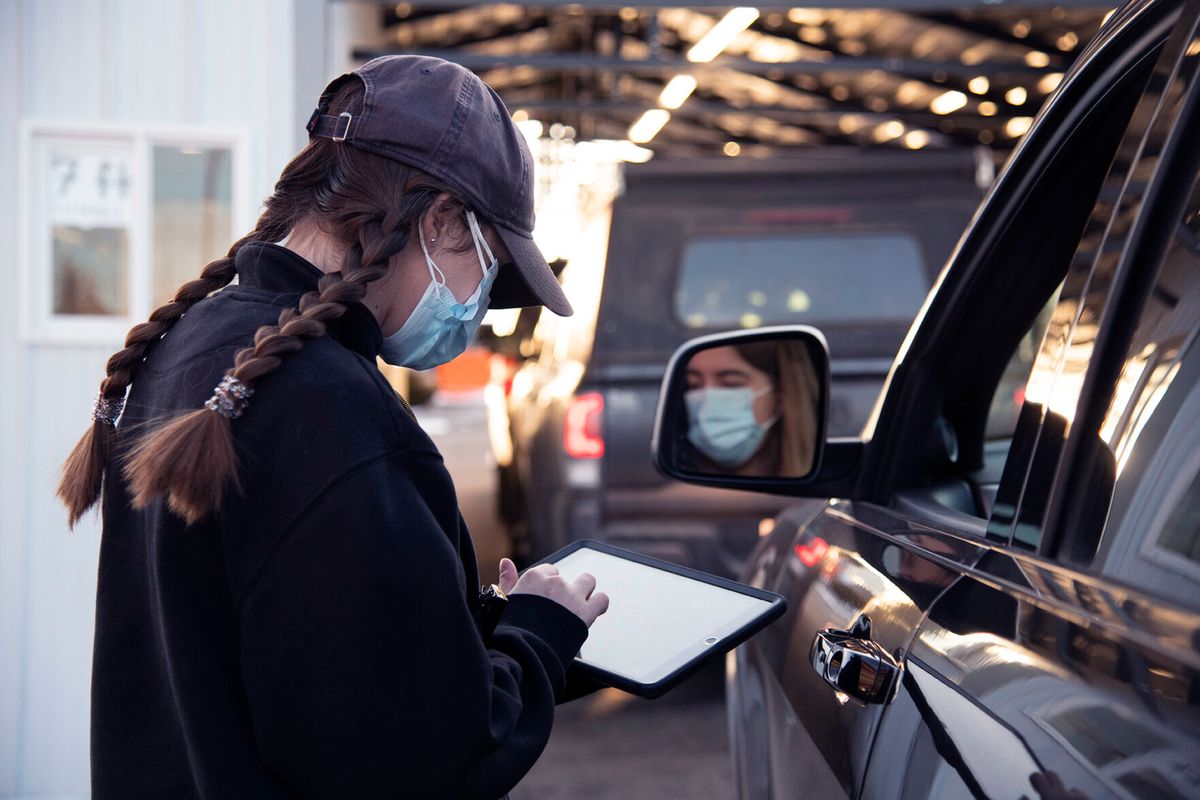
Working at a COVID-19 testing site is like running the drive-thru at a Chick-fil-A, according to Lauren Fletcher, a photo major at MSU, one of a group of students who stepped up to the window, so to speak, to help process tests through surges and lulls of COVID-19 cases in Gallatin County.
At the start of her shift at 8 a.m. on Monday, Feb. 7, Fletcher walks out of the testing shed in Lot H of Bozeman Health Deaconess Hospital, removes a cone blocking its entrance, and greets the first car that lines up with a tablet she uses to enter patients’ information. She sends their order — one COVID-19 test — into the hospital’s appointment system before the patient drives into the shed to have their nose swabbed.
This process repeats a few more times before Fletcher and her coworkers have collected enough swabs to be delivered for processing, at which point she takes a brief jaunt inside the hospital to deliver the tests via a pneumatic tube to the lab.
Fletcher secured her job at the testing sites through Best Practice Medicine (BPM), a healthcare education and emergency medical services company, which contracts with healthcare providers like Bozeman Health to provide COVID-19 screening. After completing her Emergency Medical Technician (EMT) training in the summer of 2021 through BPM, Fletcher stepped into the drive-thru. Along with liberal studies major Rob Hemingway and film major Taylor Burlage, she shared her experience working at testing sites in the county following January’s surge in testing demand, during which Bozeman Health collected an average of 550 tests day, the highest number since the start of the pandemic. The students switched between multiple testing teams and temporary sites operated by BPM throughout the county, from Bozeman to Belgrade.
Burlage, who has an EMT license, also started working at the testing sites in the fall, and Hemingway, who works as an EMT and firefighter, started working at the testing sites in August after previously working for BPM in 2020.
“It was kind of an exciting time not really knowing what was going on, but here’s this opportunity to do something right,” Hemingway said.
Some weeks the students worked were calm, but other weeks were very busy, like during the surge in cases caused by the omicron variant. During this period of high testing demand, the students said they processed more than 200 tests a day. The volume created stress for the workers, who processed specimens while addressing the anxieties and frustrations of patients waiting in line, which Burlage said sometimes extended to three hours long.
“There are a lot of traveling people or there are a lot of people who are sick and can’t be around an immunocompromised relative or partner,” Burlage said. “And so there’s a lot of anxiety that comes along from that and we kind of take it on.”
Chief among the stress-causing factors, Hemingway explained, was a lag in time between when the testers entered patients’ information for their “visit” and when the appointment was confirmed by the hospital — a step required before swabbing could happen — which could take as long as 20 minutes on a busy day.
“It’s really hard to explain to somebody quickly why it’s taking three hours to get through the line,” Hemingway said.
The students said it was also difficult to explain the differences between types of COVID-19 tests — they processed RT-PCR tests, the results of which can take 72 hours to be returned — and differences between the method of collection.Though they collected specimens with a shallow swab in the nose, some patients were anxious about the swab being pushed very far into their sinuses.
Fletcher said they sometimes had to turn patients away from the line at the end of the day when testing demand was high. “It’s really upsetting because you want to help everybody, but you can’t,” she said.
The job also required the occasional outside-of-the-box task, like jump starting peoples’ cars or comforting kids afraid of having their nose swabbed.
Though flustered patients sometimes caused trouble, most of the people driving up for tests were kind. After jumping one patient’s car, Fletcher said the testers received handwritten thank you cards from them. Another patient dropped off Halloween candy.
The testing sheds occasionally became a center of excitement when a patient dropped by with a dog in the car, according to Burlage, at which point all of the workers at the site would temporarily run out of the shed to see it. At the hospital’s Lot H testing site, pictures of dog passengers hang from the wall behind the computer station.
Over time, the students got used to the repetition of interacting with patients, swabbing and entering data. “My right wrist is huge from moving a mouse around and clicking fast,” Burlage said. Testing was an important experience for learning patient care, Hemingway and Fletcher explained, and working from small testing sheds was an opportunity to get to know each other well, Burlage said.
BPM’s contract with Bozeman Health ended on Friday, Feb. 11, as a result of a downward trend in COVID-19 cases in the county, closing the company’s testing sites until further notice. People can still receive tests through the Gallatin County Health Department and Bozeman Health, and students can receive tests at MSU’s testing site by Bobcat Stadium.



Comments ()