
TEDx: Five speakers, five stories
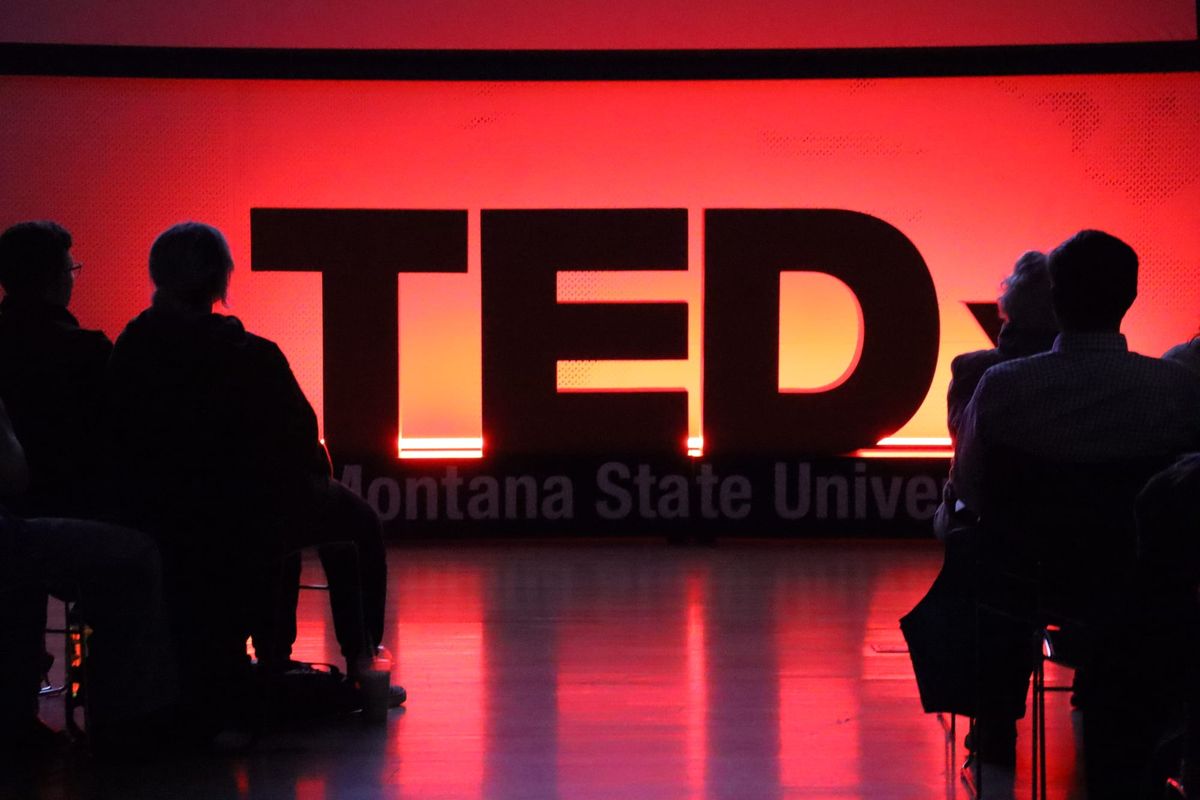
Five speakers filled Norm Asbjornson’s Inspiration Hall with stories of hockey rinks, a Moscow gunfight, a school lockdown, a brain injury and a swimming pool on Nov. 4 at the sixth annual TEDxMontana State University, themed “Cultivating Connections.”
The Associated Students of MSU (ASMSU) Events Team puts on the event each year. Nomi Friedman, ASMSU’s assistant director of events, was the primary coordinator.
“We sold out a week prior to the event and even had people showing up at the door wanting tickets,” Friedman said.
According to Friedman, planning started months earlier. After choosing speakers from a pool of applicants, the team put them on a weeks-long schedule of drafts, coaching sessions with MSU LaunchPad, slideshows and final revisions.“TED has strict guidelines in terms of speech content and original media, so we have to follow those rules to a T in order for TED to eventually publish the talks,” Friedman said.
According to TED’s website, those rules apply to TEDx events everywhere. The “x” stands for an independently organized TED event, run by local organizers under a free license from TED. The program began on a college campus: The first independent TEDx event, TEDxUSC in March 2009, sparked a global phenomenon, growing to over 8,000 events in 1,200 global communities, according to a Medium post by Randy Bretz.
According to Friedman, Montana schools have joined in too. TEDxBillings was held at MSU Billings’ Petro Theatre in October, and the University of Montana Western posted eight talks from its spring conference to the TEDx Talks YouTube channel.
Pete Kamman, associate head coach of the Bobcats Hockey club, opened the night with his speech. Kamman coached hockey in 15 countries across six continents for more than 20 years. He described arriving in Namibia knowing no one, as well as the day an 8-year-old player gave him a warthog tusk — the first she had ever shot — as a sign he was welcome. “Common ground starts when you’re willing to be the one that doesn’t belong,” Kamman said.
Kamman, who recently finished a master’s degree at MSU, said his research found camaraderie, not fitness or trophies, is the top reason adults keep playing hockey after youth leagues. He recalled sharing tea on the frozen Indus River in Ladakh, India, with the coach of an Indian border-police team.“The game got us together, but the bond and the connection happens after that game in the slow moments,” he said.
Speaker Otto Pohl, a former New York Times photojournalist and MSU mentor in residence, began with the day he was shot, Oct. 3, 1993, caught in the fighting of a coup attempt in Moscow. He had moved to Russia three weeks after college graduation with almost no plan. The move led to lifelong friendships and a job as the New York Times’ Russia bureau photographer.
“I want you to take a leap into the unknown, think of the one brave, scary thing that you could do to pull yourself out of the comfort zone. I know the one thing I can guarantee you, and that is that you will be surprised by the people that you meet,” Pohl said.
Following Pohl, Kaylee Wolfensberger, Miss Montana 2024, spoke about her experience at 16 when a code-red lockdown sent her to the corner of her math classroom, where she texted her mom “I love you.” About a month later, she sat down at the piano and felt like she could breathe for the first time since that day. She spent her year as Miss Montana advocating for music access for kids facing adversity.
“Connection and communication aren’t the same thing,” Wolfensberger said. “Communication is about an exchange of information, and connection is about a shared experience, and music has the ability to bridge that gap.”
Next, Neurology Nurse Practitioner Mandi Swanson went from provider to patient after an April 2023 car accident left her with a traumatic brain injury. It took her almost two years to return to work part time. Friends, colleagues and her podcast, “Brain Wellness,” connected her with specialists from neuro-optometry to neurofeedback, bridging the gap between the patient and the provider.
The last speaker, Linda Elkins, an engineer and triathlete who spent about 25 years at Gore — the company behind Gore-Tex — closed the lineup. A former collegiate swimmer, she spoke about how a conversation with the swimmer in the adjacent lane at the Bozeman Swim Center eventually led to her appointment on Bozeman Health’s board of directors.
“The most valuable connections and relationships are often the ones whose future you cannot see,” Elkins said.
Friedman said audience members praised how professional and smooth the night felt. The only hiccup was a minor microphone issue, which the production team quickly fixed.
“This event is a testament to the notion that everyone has a story to tell, and that these unique experiences have the ability to actually bring people together,” Friedman said.
Comments ()