
Thrusters on full to a better future: Star Trek’s stories are about us
38 years, 11 months and 26 days from now, an intelligent alien species will touch down on Earth in Bozeman, Montana. Humans will then peacefully make first contact with extraterrestrials, and April 5, 2063 will go down in history as a day that changed the course of humanity’s future forever.
Well, that’s what happens in Star Trek, anyway.
April 5 is called “First Contact Day” in the Star Trek universe. It’s the day a passing alien survey ship detected humankind’s first faster-than-light interstellar flight and decided to investigate. Once on Earth, the alien captain stepped out and shook hands with the Montanan inventor Zefram Cochrane, who designed the spaceship that made the flight. The idea was that because of our technological advancement, humans were developed enough to meet the other intelligent life forms of our universe.
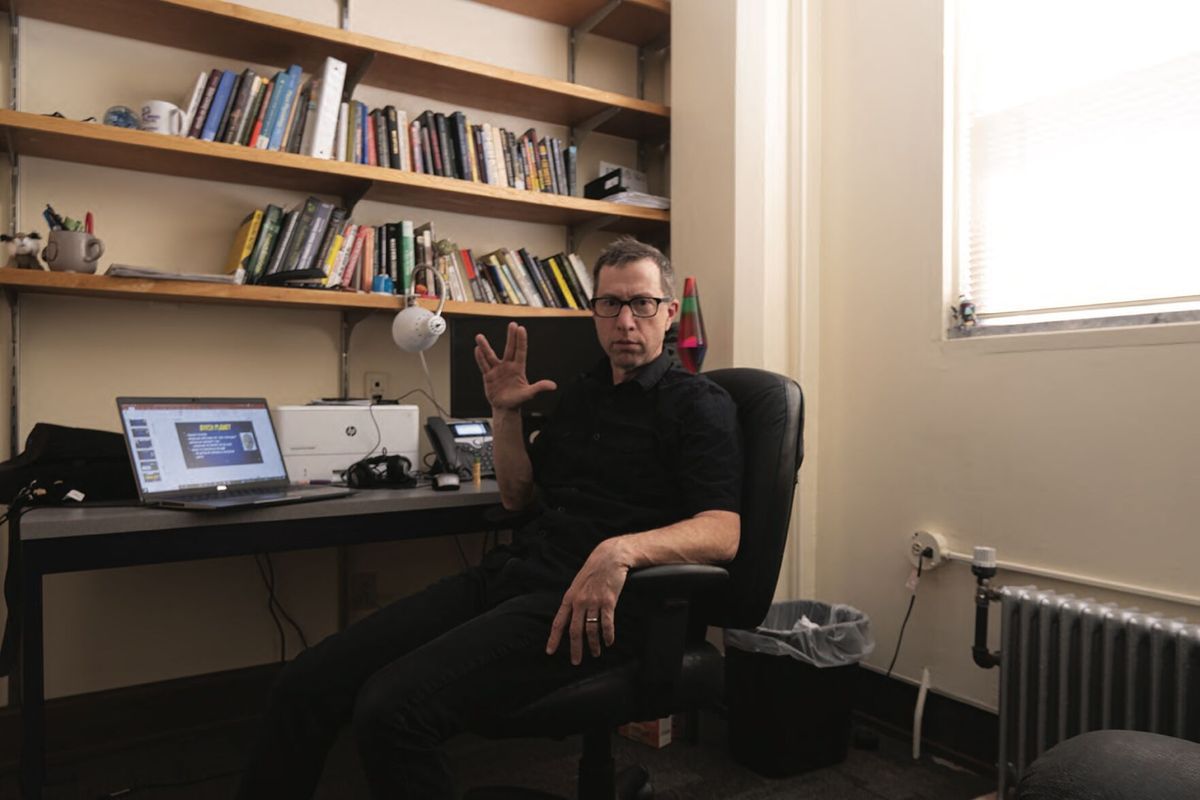
“It’s science that's untethered. It's not rooted in limitations or the constraints of physics. It's science unbridled,” animal behavior and cognitive science professor John Townsend-Mehler said. “It opens our imagination to what can be. It presents the question: Oh, well, what if we were able to do those things? What if we did have a warp drive? What would that allow us to do? To me, that’s one of the huge functions of science fiction, to ask those questions and present us with a way of seeing what is possible.”
Townsend-Mehler, who teaches LS 301: Science & Cinema, explained that Star Trek is inherently subversive. “There's so much going on beneath the [obvious plot points]. The show is so much more complex than it’s often given credit for,” he said.
On Sept. 8, 1966, “Star Trek: The Original Series” (TOS) made its first television debut, according to MSN. Its special effects were very low-tech even for the ‘60s. Instrument panels were made of painted plastic, a small dog with a unicorn horn represented alien life and whenever there was a shot of the ship’s engineering section, every electrical pipe was labeled “G.N.D.N” — goes nowhere, does nothing — which was an inside joke among the set designers.
However, TOS was never a run-of-the-mill ‘60s show even with its low-cost effects. It was a show that made progressive political commentary, including discussions of racism, race relations, nationalism, gender roles, militarism and imperialism; all prominent issues of the 1960s — and today. Additionally, from the launch of the first series in ‘66, the Star Trek canon quickly grew to include twelve television series and several feature films that continue to be produced to this day. The franchise is almost 60 years old now and still going strong.
“We must learn to live together, or most certainly we will soon all die together,” was how the series’ creator, Gene Roddenberry, explained his show’s message to Time Magazine before he died in 1991. Roddenberry was determined to demonstrate this message of tolerance and diversity to audiences through the show’s progressive messaging. For example, the multicultural cast of TOS was revolutionary for the time. The bridge crew included an Asian helmsman — played by George Takei — and an African communications officer — played by Nichelle Nichols — among various other ethnicities and nationalities. Nichols’s character, in particular, marked the first time U.S. television viewers ever got to see a Black female main character who wasn’t stereotyped, according to the Washington Post.
Her character was so important to civil rights advocates at the time that Martin Luther King Jr. took time to meet her personally on set. In an interview with NPR in 2011, she explained that when she first shook his hand, Nichols said, “I wish I could be out there marching with you.” However, King told her, “We don’t need you to march. You are marching. You are reflecting what we are fighting for.”
Nichols wrote in a 2015 Reddit post about Roddenberry’s vision for humanity’s future: “He didn’t talk about it, he just did it. It was who he was. He believed in that world. If you got it, you got it. If you didn’t get it, you’d see it anyway.”
Townsend-Mehler explained something inherently special about Star Trek is it amplified the idea that technology could be used to help lay the groundwork for a global utopia. “You know, just by the very fact that the bridge of the Enterprise is egalitarian; it's multicultural. As we get to know reality better through science, we could pave the way for a more egalitarian future. The notion that technology or science could potentially be this gateway to a better, more equal society is a fascinating idea,” he said.
Star Trek represents more than just aspirations of a brighter future. For some people, its effects are tangible. Senior Julian Soucy, who chose his first name after the character Julian Bashir, explained what Star Trek meant to him. “Everything. It’s my life. Star Trek is basically — it's a gay icon. Can I say that?” he said, laughing. “My name has been my anchor for the last two years and I can thank Star Trek for it.”
Soucy explained that his favorite thing about the franchise is the breaking of gender norms and the exploration of personal identity. “My favorite episode is season five, episode 16 [of DS9]. That was when Julian Bashir came out as being genetically engineered. I watched that episode with my mom, and that was how I came out as being trans. There's a dialogue line in there, where he [was with] his family, who’d nicknamed him Jules. And he stands up so angrily and he's like, that's not my name. I'm Julian now,” he said. “And I looked at my mom and I'm just like — so, Mom, I have something to tell you.”
Soucy explained that the greatest message Star Trek provides to a contemporary audience is its representation of diversity. “Here we are in space getting along with aliens and having interspecies relationships and things like that. And on Earth [now], we're still not to that point where we even accept all humans. But in Star Trek, that's not an issue.”
“I think [Star Trek] had the first interracial kiss, it also had the first onscreen lesbian kiss in Deep Space Nine [DS9], which was awesome. I find myself in Star Trek because it's literally phenomenal. Each series has a different way of tackling things, different political intrigues,” he said.
“I remember back when I was in high school, people who played [games like] Dungeons and Dragons were not liked,” he said. “They were nerds, they were distanced. But nowadays, it's a big popular thing. And I feel like the same is happening with Star Trek and Magic the Gathering. Nerd was a bad thing, and now people are just kind of owning it.”
Townsend-Mehler also reflected on the general perception of Star Trek as being a “nerdy” franchise.
“Maybe it's easy to make fun of a show that is so earnest about something; that has a heart to it. I think it was incredibly ambitious television for the time. I don't think anything on television effectively mimics or even attempts to wade in that same pool as Star Trek has been doing,” he said.
In many ways, Star Trek depicts human hopes, dreams and fears about the future and addresses serious issues and ideas in a way that had never before been seen on American television. David Gerrold, a writer for the series, explained it best when he wrote in his autobiography that "the stories are about twentieth-century man's attitudes in a future universe. The stories are about us.”
“To come back to the purpose of science fiction — what does it do for us? The idea Star Trek presents us with is possibility,” Townsend-Mehler said. “I can't imagine a more awesome future for the planet, for our species, than having some sort of intergalactic federation of planets of all creatures, all beings. What an amazing aspiration to have.”
“I also think it's kind of this grand metaphor for day-to-day tolerance — being able to be curious about other people and the importance of being curious, too,” he continued. “The idea that to be curious about something is a way of honoring it. To be curious is a way of legitimizing and valuing. I think when we're incurious about things, that's to our own detriment. That's what the show is really about. How we better ourselves and show basic respect for other beings and cultures.”


Comments ()