
Tour de Franzia spills out onto Bozeman streets
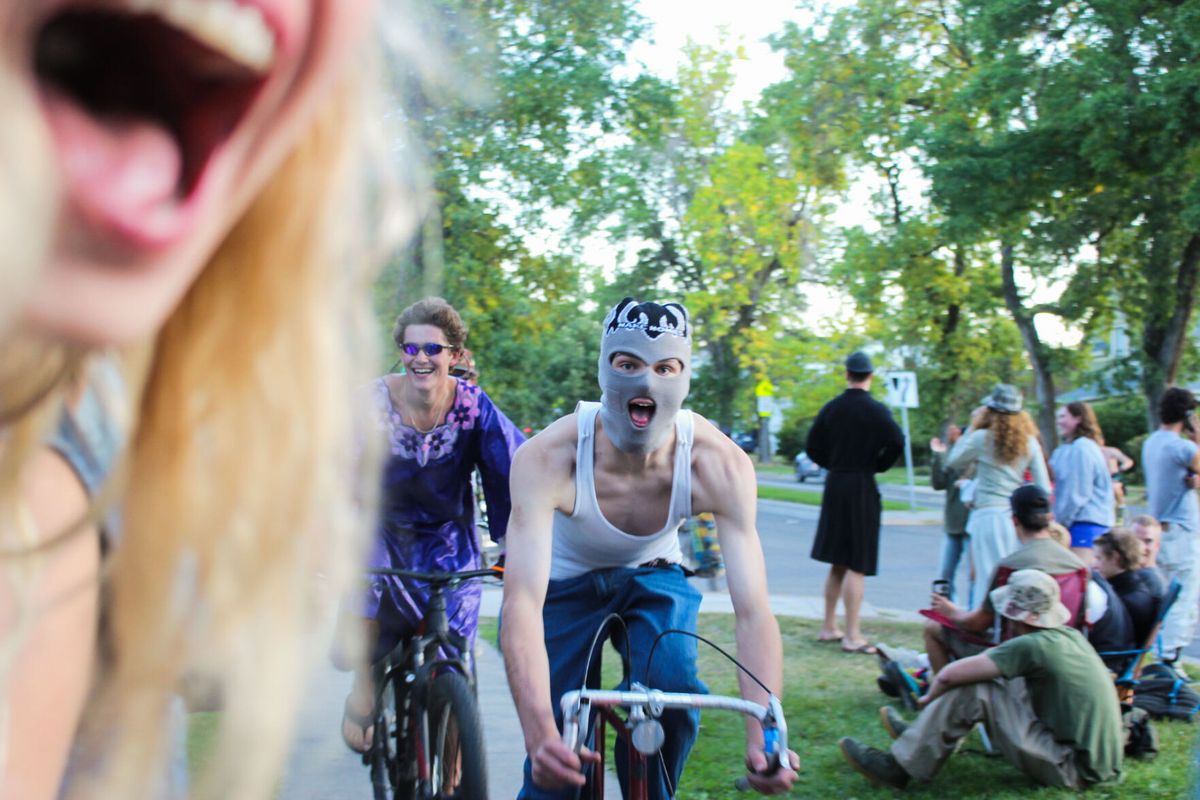
If you passed by Cooper Park last Friday, you might’ve thought that Halloween had come early — and brought boxed wine with it.
A crowd of several hundred people, dressed in costumes and sipping from large translucent bags of wine, congregated on the grass and spilled out onto South 8th Avenue. Their mission? To combine outdoor recreation with another popular college pastime: drinking, and lots of it.
As whoops and hollers filled the air, the rambunctious gaggle took off on their wheels to begin a wine-fueled bike race around Bozeman — also known as the Tour de Franzia.
The tour — which inherited its title from the popular brand of boxed wine, Franzia — is a biannual tradition organized by members of the MSU community. The event typically bookends the academic year, with the first tour taking place in early September and the second occurring in the first weeks of May.
Though the Exponent was unable to confirm the exact origins of the event, the MSU Dean of Students Matt Caires said that he has known about it since he began working at MSU in 2011.
This year, most participants arrived around 6:30 p.m., many in teams of four and dressed in coordinated costumes, to race the eight-mile loop. The route took riders south along sections of the Galligator Trail and the Sourdough Trail network before heading back up to Cooper Park. Along the way, participants would stop intermittently to socialize and chug from bags of wine.
While many drank directly from the bag's nozzle, others opted for a more sophisticated approach. Sophomore Hank Morgan — who originally outwitted the Exponent reporter on scene and falsely identified himself as Frank Wonkler of Wonkler Industries — sipped from a glass. “I’m here to ride my bike really fast, drink wine with class and have a good time with my buddies,” he said.
Another group of students in the crowd — who identified themselves as Kellen the Blue, Dylan the Green, Gus the Wicked and Kole the Tattered — were dressed as wizards and passed a bag of Franzia between them to fill their glasses.
“We will be first or the world will be last,” Gus the Wicked said when asked if they saw themselves as formidable competitors for the evening’s race.
When asked why they were not wearing helmets, Kellen the Blue said: “I [cast] protection on myself, I am fine.”
When the race was completed, participants kept the party going at Cooper Park well after sunset.
Civil engineering major Benji Schaal sported a Hawaiian grass skirt, lei and coconut bra. “I’m just trying to find a f---ing cigarette,” he said when the Exponent began the interview. After a brief intermission — wherein someone handed Schaal a lit cigarette — he continued speaking. “Everyone f---ing is hype. Everyone’s hype — name one person that’s not hype,” he said.
According to Schaal, anyone can have fun at the event, regardless of whether they consume alcohol. “You do not have to drink. You can just bike. Biking is fun — wear a helmet though,” he said.
There was one group of participants who were skeptical of the tour. They donned tinfoil hats and stood off to the side of the main crowd. After getting confirmation that the Exponent would not share the information they provided with the government, the group offered insight into possible malfeasance taking place.
“Big Franzia, they’re funding this whole event,” said chemistry major Kyce Morgan, a self-proclaimed conspiracy theorist. “You got to buy other wine.”
When asked about other possible threats to the event, Morgan listed aliens, chemtrails and radio waves.
Business major Paige Lepard attended the event with her friends, each of them dressed as a founding father. Lepard, who was dressed as the U.S.’s first Treasury Secretary Alexander Hamilton, spoke about the cultural significance of the event to MSU.
“I truly believe the Tour de Franzia is a pillar of the Bozeman community,” Lepard said. “[It] is the intersection of the cultural environment here at MSU. We're a very outdoorsy school. But again, we're college students, so we like to go out and have fun, have a good time.”
Although the enthusiasm at the tour was palpable, the event did not go off without a hitch. According to Detective Quinn Ellingson — who was present in Cooper Park at around 8 p.m. on Friday night — the Bozeman Police Department was receiving calls about bikers running into cars, blocking traffic and disturbing people in the surrounding neighborhoods.
“Everybody seems to be having a good time. Our biggest concern is, obviously, everybody's safety,” he said.
In an interview with the Exponent after the event, Associate Vice President of Student Health Betsy Asserson said that Bozeman Health treated 14 traumas on Friday night related to the tour. This is a 55 percent increase from the tour last May, when nine were treated.
“We can see that we're heading towards something really bad. So how do we get out ahead of that and try to have some prevention? So it's not something that we see escalating to a really significant tragedy.” Asserson said.
Due to these safety issues, the event has caught the attention of University officials, particularly in recent years. Dean of Students Matt Caires said that, while the tour successfully promotes community engagement, there are some serious concerns regarding student safety.
“In many ways, it's a tradition founded on some neat principles: riding bikes, our outdoor community, dressing up and having fun. And so there's — at the core — some really good things that come with this,” Caires said. “It's become a dangerous tradition. And we continue to be concerned about high-risk drinking and the injuries associated with it.”
Caires also reflected on how the event impacts the University’s relationship with the community. “This is not a great representation of our students,” he said. “At six o'clock, there's some enthusiasm. Students are gathering, they're dressing up, but as the night goes on, the neighbors get extremely upset. The noise, the congestion, the danger.”
Despite these concerns, Caires said he wants to work with students to make the event safer. He referenced his office’s work with Greek life, where the University regulates off-campus functions. Caires recommended designating older students to take ownership of the event and look out for younger participants.
“You help people get home after the event is done. You help monitor the alcohol consumption. And if you see someone consuming too much, you take away their participation,” Caires said. “We expect some 21-year-olds and 22-year-olds taking responsibility and ownership to make sure that nothing terrible happens to an 18 or 19-year-old.”
Caires said that if the tour continues on its current trajectory, a tragedy or a significant response from law enforcement is imminent.
“We want to partner with a small group of student leaders to make some important reforms to the event,” he said. “And we're waiting to hear from [event organizers] on how we can do a much healthier, safer event.”
Comments ()