
“We had a very diverse culture”: A look into Bozeman’s roots
Many may not recognize the names of Black pioneers Samuel Lewis or Lucille Smith Thompson, but in the heart of downtown Bozeman, The Extreme History Project (TEHP) is committed to sharing their complex history.
TEHP is a 501(c)(3) non-profit public history organization that was created in 2012 by co-founders Marsha Fulton and Crystal Alegria. “The mission is to make history relevant,” said Alegria, who serves as the executive director of TEHP.
“When we have the full [history] of women, people of color, people with different ideologies [history] is so much more interesting and so much more complex,” she said. “We will not stop telling these stories, even if we get pressure not to.”
In recognition of Black History Month, TEHP sat down with the Exponent to discuss the Black men and women who played a role in shaping Bozeman.
“We had a thriving Black community in the early days of Bozeman,” Alegria said. “Bozeman was founded in 1864, and shortly after, Black community members started settling here after the Civil War.”
In 1868, Haitian-born Samuel Lewis came to Bozeman and established a barber shop on Main Street. According to Alegria, he was regarded as a prominent figure in Bozeman.
“In his obituary, [it says] he was a very prominent member of this community and he was very respected but [they wrote] that he knew his place,” she said. “So you can tell just through that obituary how the black community members were treated even in the 1890s.”
Alegria explained that one of the first Black families to settle in Bozeman were Richard and Mary McDonald. “Both Richard and Mary grew up enslaved and freed and moved here,” Alegria said. “They lived here the rest of their lives. The house they built is at 308 S. Tracy Street.”
The McDonald house still stands and was gifted in 2000 to Bozeman local Bob Nute by a descendant of the McDonald family.
“Bob and [his wife] still have some of the artifacts of the family, like a little tin box that [the McDonalds] brought with them,” Alegria said. “Every night along their [travel] they would bury [the tin box], so that if someone came and tried to steal from them, they wouldn't get all their valuables.”
Some of these artifacts are kept in the MSU Library Archives, including the McDonald family cookbook, which was compiled by descendant Belle McDonald.
According to Alegria, the McDonalds had three sons and three daughters. While none of their sons survived to adulthood, their daughters remained in Bozeman into their later years. According to an article published in the Bozeman Daily Chronicle in 2020, one of their daughters, Mollie McDonald, worked for MSU as the head cook in Hamilton Hall shortly after the hall was built.
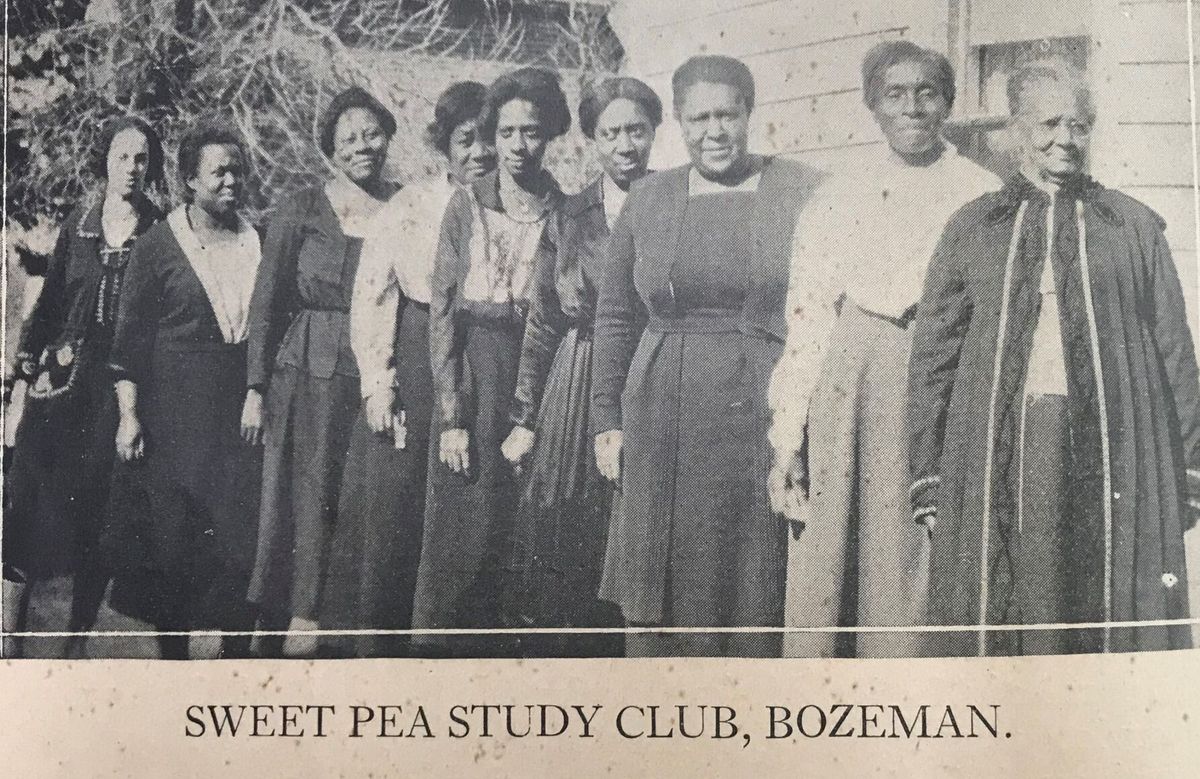
“The daughters of Richard and Mary were very involved in the Sweet Pea Study Club, which was a chapter of the Montana Federation of Colored Women's Club,” Alegria said. “This was really popular in the 1920s. They were strong and really helpful to one another. They would talk about things that were important to them, how to make their lives and their families' lives better.”
Alegria explained that women's clubs were a networking force for Black women. They were created because these women were excluded from groups with white women. Around this time, the rise of segregation caused a shift in the numbers of Black men and women in Bozeman.
“In 1909 [Montana] passed an anti-miscegenation law, which means you can only marry someone of your own color,” Alegria said. “It shows the ramping-up of racism from that time. The law was repealed in 1953. It wasn’t that long ago. Isn’t that crazy?”
According to Alegria, many communities of color were pushed out of Bozeman in the 1920s as a result of racism, the prevalence of hate groups and the changing economy.
“There was a lot more diversity here in the early days than there is now,” Alegria said. “I always say — if you walked down Bozeman Main Street in the 1870s, 1880s, you would have heard Samuel Lewis with his British-Haitian dialect, you would have heard Lizzy Williams’ deep Kentucky drawl. You would have heard all these different languages on Main Street. We had a very diverse culture — it's become very white.”
Alegria also connected historical events to today's political climate surrounding immigrants. “History does repeat itself, unfortunately,” she said. “We can’t seem to figure out how to not repeat ourselves. A lot of those communities of color were pushed out at that time and they just haven’t repopulated.”
During the summer, TEHP hosts “Historic Walking Tours,” guiding participants through different areas of Bozeman with significant historical relevance. According to its website, these tours explore the city's past, highlighting notable events, influential figures and architectural landmarks that have shaped its development.
“We have two African American tours,” Alegria said. “We have a North Side black community tour and we have a South Side black community tour, because we had neighborhoods on both sides of Main Street that were really prominent and really vibrant.”
According to Alegria, the “Historic Walking Tours” will start at the end of May. To find out more information, visit https://extremehistoryproject.org/the-extreme-history-project-walking-tours-schedule/.


Comments ()