
‘Why should our sculpture be idle?’: Iconic Noodle sculpture turns 24
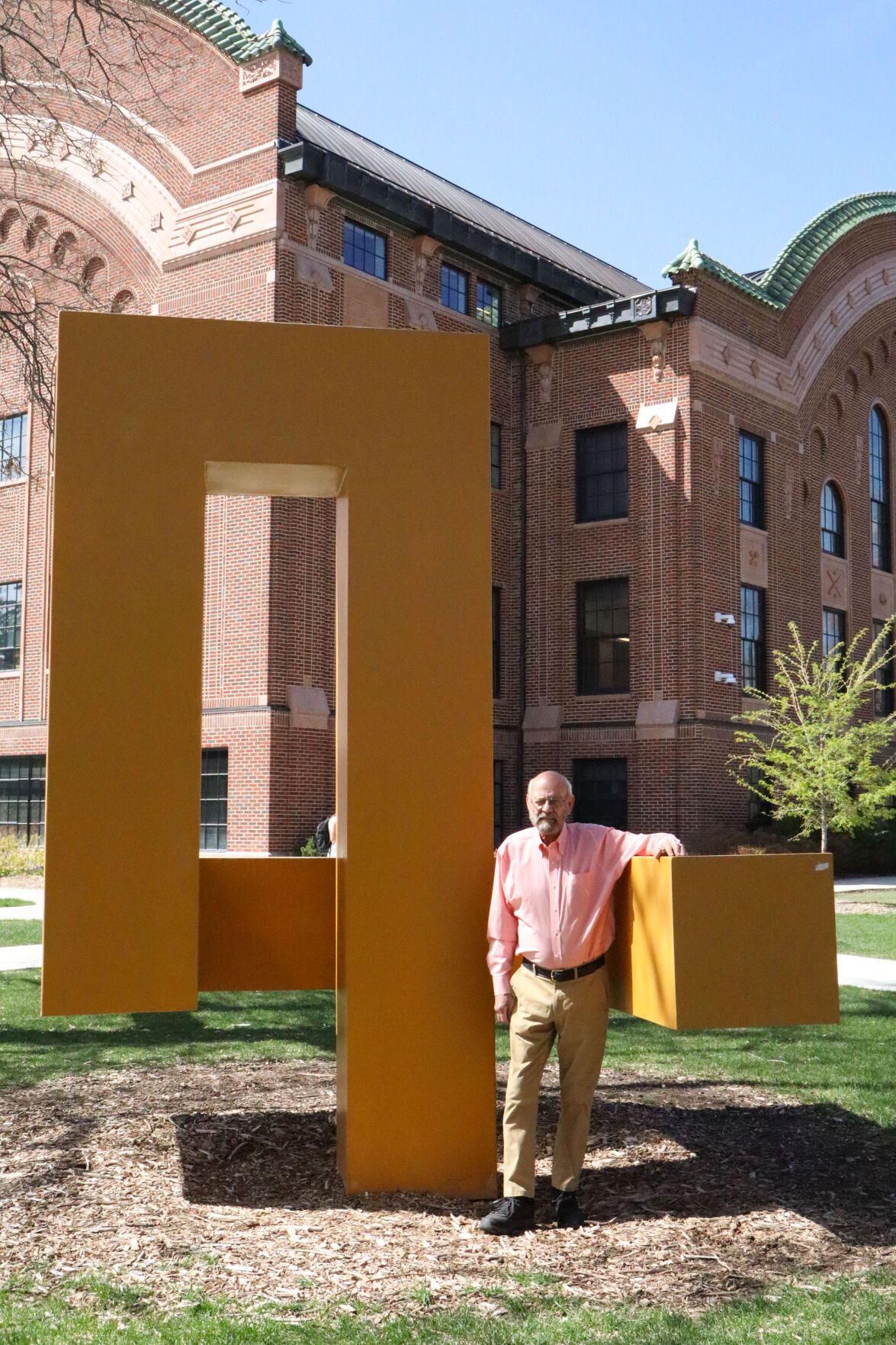
The Noodle — the pasta-shaped statue between Barnard Hall and the Strand Union Building — has been a beloved campus feature for years. The curve represents the saddle coming down from Ross Peak in the Bridger Range, which its creator Gary Bates grew up seeing every day.
Bates is responsible for two familiar pieces of art everyone on campus is familiar with: The Big Yellow Four in Romney Oval and most notably, the Noodle. April 13 was the 24th anniversary of the Noodle becoming a part of campus life.
Bates was born in Amsterdam, Montana in 1946, and recently celebrated his 80th birthday. He attended MSU for his freshman year in 1970 before transferring to University of Montana (UM). During his time at MSU, Bates won a competition to build a campus statue. He subsequently created The Big Yellow Four, which is still standing in Romney Oval to this day.
Bates said that winning the contest as a freshman made him unpopular, as he was competing with graduate students in architecture and engineering.
“I was the newbie on campus,” he said. “But I’ve always built things to surprise and delight myself and that is hard to do. So, if I can surprise and delight myself, maybe I can delight others.”
After spending a year at UM, Bates was offered a scholarship to the Kansas City Art Institute (KCAI), where he earned his Bachelor of Fine Arts in 1975.
Bates said that his ability to surprise and delight is what won him this scholarship. He told a story about inflating a giant statue out of a suitcase in front of the selection committee and watching it roll out of sight.
“We walked back into the conference room, and the chairman of the department said, ‘That performance has just gotten you a full-ride scholarship to this institution,’” he said.
After graduating from KCAI, Bates was offered a full ride to Yale University, but said that he missed the mountains too much and turned it down.
“I knew that I would become a college professor if I graduated from Yale, because that is the easy path,” Bates said. “And whether I am hiking in Yellowstone or I’m charting a career, I always take the hard path, because that’s where the learning is.”
After graduating from college, Bates began working for the National Park Service at Yellowstone while creating sculptures on the weekends. There, Bates worked on public utilities, such as fixing staircases.
“My role was different because I saw things that the park needed to have done, and I would do a blueprint and a cost analysis, and I wouldn't have an individual boss. I went directly to the superintendent of the park and said, ‘This is what I would like to do, and these are my qualifications to do it,’” he said.
Bates worked at Yellowstone for 14 seasons, while also lecturing about his works and continuing to create public art, including MSU’s own Noodle — or as it’s officially named, Wind Arc.
Bates spent over two and a half years creating Wind Arc. During this time, he continued working in Yellowstone in the summer and served as an adjunct professor at MSU in the winter. On April 13, 2002, Wind Arc went up on campus.
His idea for the Noodle originated from an advanced sculpture class at MSU where he was invited to submit a proposal alongside 236 other artists for a new piece on campus.
“I wanted to show my class how to do a proposal,” Bates said. “And in one week, I did the proposal, I did the model, the engineering and the photography.”
Although the piece is called Wind Arc, Bates is not opposed to the nickname that students have come to know it by over the years. He sees Noodle as a term of endearment that demonstrates how Wind Arc has made its way into students' daily lives.
“I appreciate nicknames,” Bates said. “The only way public art is not important is if no one notices it. If they notice it and nickname it, then it's part of the culture.”
He said he loves kinetic sculptures like Wind Arc because they represent our world as a whole.
“We live on a moving planet, in a moving universe, so why should our sculpture be idle?” Bates said. “I am building this for my enjoyment. This is my passion.”
According to Bates, he has never taken an engineering or physics class, even though those two disciplines go hand in hand with kinetic sculpture. Instead, he focuses on intuition.
“When I was lecturing at Stanford — it's just row after row in the Annenberg Auditorium of Ph.D.s — I said, ‘Who in here trusts their intuition?’ Not one hand went up,” he said. “I said, ‘Who in here trusts your calculations?’ — they all trust their calculations. I don't do calculations. And I said, ‘That doesn’t mean that what you're doing is wrong and what I'm doing is right, it just means that we are different.’”
Bates has lectured to every imaginable age range and type of person, from people in Silicon Valley to children in the one-room schoolhouse he attended years ago in Amsterdam. He said that without a doubt, young kids are his favorite to speak to.
“I say, ‘How many of you are artists?’ and a couple put up their hands very meekly. I said, ‘I want you to know you are all artists. Unless it is suppressed or it is held back, you are all artists, and you can do what I do,’ because that is what I did,” he said.
Bates said he is still amazed every time he sees Wind Arc, even two decades later.
“It was amazing 24 years ago at 10 o’clock when I saw it run for the first time, and it still is amazing to me today,” he said.


Comments ()