
Yellowstone as the wellspring for global thermophilic microbe research
For reasons still unknown to science, thermophilic microbes thrive both in the hydrothermal environments of Yellowstone National Park (YNP) and deep-sea interfaces in the Gulf of California. Despite massive differences in water-depth and climate, bacteria and archaea thrive in both places — and MSU researchers are hard at work studying them.
Research on thermophilic microbes is ongoing through MSU’s Thermal Biology Institute (TBI) and its affiliate researchers both domestically and abroad. Thermophiles are moderately thermophilic bacteria, meaning they can survive at a temperature of 45℃, or 113℉. Thermophiles were first discovered in 1967 in YNP by microbiologist Thomas Brock and graduate student Hudson Freeze from Indiana University. Brock and Freeze “were able to isolate a novel bacteria, Thermus aquaticus, in the Lower Geyser Basin of YNP,” according to the TBI’s website.
One of the priorities of the TBI’s work is outlined on their website as “[contributing] to the advancement of education and public awareness of the biocomplexity of geothermal environments.” These research goals are also shared by TBI research affiliate and MSU professor Dr. Roland Hatzenpichler and his lab. Hatzenpichler’s lab also conducts fundamental research on uncultured bacteria and archaea in cold and hydrothermal deep-sea sediments.
These sediments and microbes coexist in both very high and very low temperatures on the seafloor. According to the National Library of Medicine, “the hot zones of deep-sea hydrothermal environments are inhabited by diverse thermophilic or hyperthermophilic archaea and bacteria, growing at temperatures ranging from moderate to the highest at which microbial growth has been demonstrated.”
At the time of the discovery of Thermus aquaticus in 1967, it was living in an environment of 70℃ — or 158℉ — which was the highest environmental temperature for any known organism, according to the TBI website. The question of how microbes could survive in such extreme conditions was concluded to be the existence of a thermostable polymerase that could endure elevated hydrothermal temperatures during the process of DNA synthesis.
A key component of DNA replication is the presence of a polymerase, an enzyme that can synthesize long sequences of nucleic acids, which are the building blocks of genomes. A thermostable polymerase is one that can resist temperatures between 45℃ and 120℃, as outlined in a 2023 National Library of Medicine journal article byresearchers Che Haznie Ayu Che Hussian and Wai Yie Leong.
After the extraction of the thermostable enzyme – Taq polymerase – from Thermus aquaticus, Taq was used to create the Polymerase Chain Reaction (PCR) test, in which samples of DNA strands are repeatedly heated and cooled for efficient replication. Escherichia coli (E. coli) was originally used for PCR as it is easily replicable in the lab, but was ultimately replaced because unlike Taq, E. coli would denature, or deteriorate in the high temperatures required for DNA strand separation, according to the same article by Hussian and Leong. Fragments of DNA called primers are used in PCR to isolate a segment of the genome that researchers want to amplify.
PCR tests are now irreplaceable in modern biological practice due to the efficiency they provide in replicating DNA sequences. In his interview with the Exponent on Nov. 2, Hatzenpichler said, “Every field had this one transformative moment that catapulted the field from the old age into the new era and for arguably biology in general this was the invention of PCR.”
According to an article from 2017 by French researcher Christine Pourcel, published in French, three studies by different researchers were published in 2005 in an “independent manner,” showing that spacers, which are fragments of foreign DNA, corresponded to viral or plasmid sequences. These independent discoveries of spacers were fundamental in further CRISPR research because the existence of spacers demonstrated that the organisms had the mechanisms to edit their own DNA if they could incorporate fragments of viral DNA into their own genomes.
The study of thermophilic bacteria directly led to the invention of the PCR test as well as the discovery of CRISPR systems in microbes, and thus one cannot be adequately covered without discussing the others. Though their origins lie in hydrothermal environments such as YNP and the Gulf of California, the wider applications of CRISPR systems affect not just microbiology and biochemistry, but also broader realms of biotechnology and the possibility of gene-editing in more complexly structured organisms, such as humans.
Wider CRISPR discoveries would also not be possible without the work of TBI research affiliate Dr. John Van der Oost, who works at Wageningen University in the Netherlands. He first met MSU researcher and TBI faculty member Dr Mark A. Young in the early 2000s. In late spring of 2006, Van der Oost studied in Young’s lab for five weeks and did so again in 2008. Van der Oost also described an instance when he was asked to evaluate the TBI where he and other researchers, including Dr. Bill Inskeep, stayed in YNP for three days.
“That was great fun, of course, but we also had very serious discussions on what was good and what could be better. When I think back about interactions with Bozeman, it was that perfect combination of doing great science with very good scientists, but also to have a lot of fun,” he said.
Describing his research process, Van der Oost said, “next to these CRISPR arrays [which contain the spacer sequences discovered in 2005] you have CRISPR-associated genes [also known as] cas genes. So we started by expressing those in E. coli for practical reasons. We expressed them in an E. coli strain that didn’t have its own CRISPR system and then we could make combinations of the different genes and we made a synthetic CRISPR array.”
This process of creating a synthetic CRISPR array in a bacteria that did not have its own CRISPR system was in efforts to understand how the mechanism worked, since it is easier to create in large quantities for applied research in the lab.
Van der Oost said that at the time of his early CRISPR research in the mid-2000s, the function of these mechanisms was still unknown, “so we were kind of the first who could discover some of the mechanistic properties of the system.”
As for the current scope of the properties of CRISPR, “[it] is an adaptive immune system that defends most archaea and many bacteria from foreign DNA, such as phages, viruses and plasmids. The link between the CRISPR-Cas system and the optimum growth temperature of thermophilic bacteria remains unclear,” according to the National Library of Medicine.
Where much of microbiological research is focused on applied research — work that is conducted in a controlled lab environment — Hatzenpichler’s research of thermophilic microbes involves fundamental research, which he describes as the process of understanding “how organisms actually live in their native habitat,” according to him.
Hatzenpichler describes that one of the most interesting things to him is the question of how a microbe can deal with the rapid temperature change in the deep-sea over such a short time span. “Water is constantly mixing and so what that means is a microbe might find itself one day in ice-cold water, and the next day in a boiling temperature, so there’s a very wild fluctuation,” he said in his interview with the Exponent on Nov. 2.
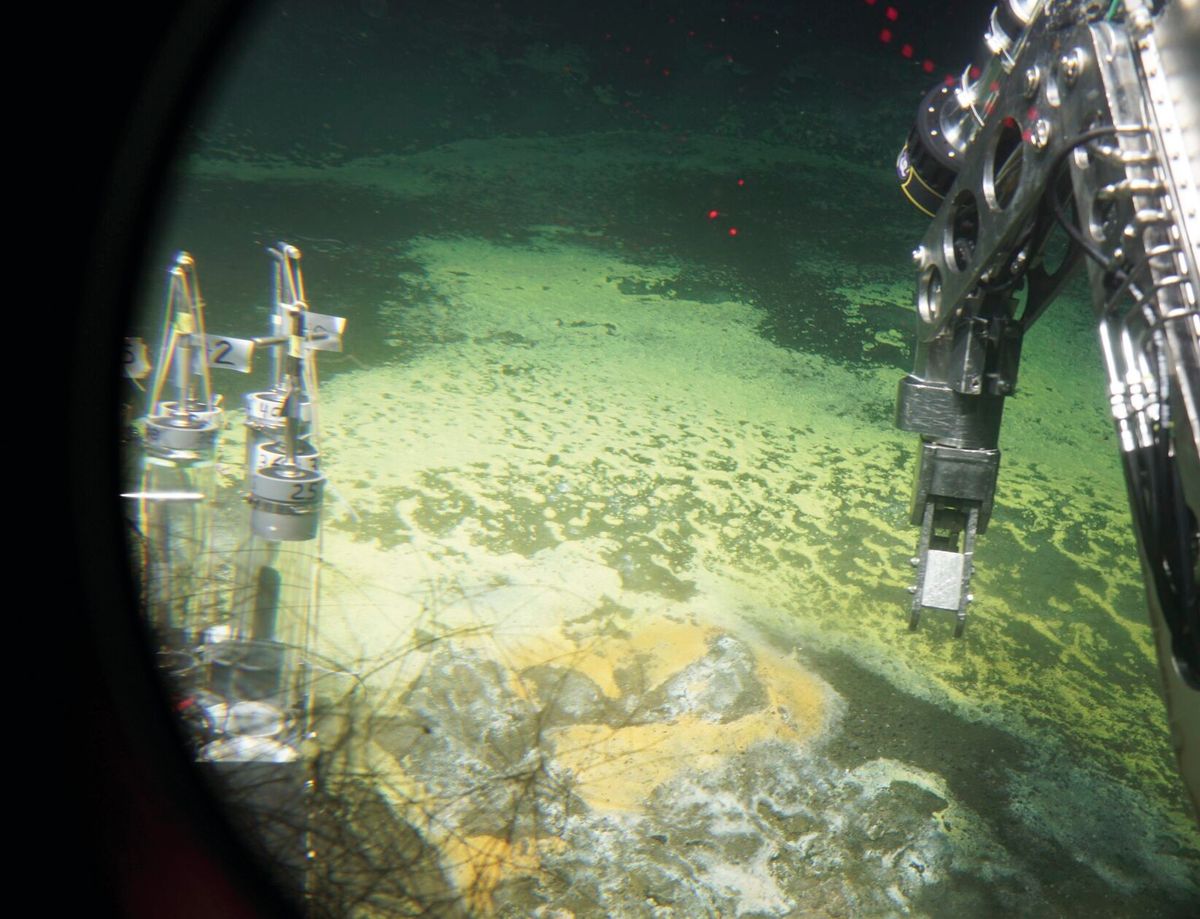
Describing an image of a bacterial mat on the seafloor taken by the submersible “Alvin” on a trip to Guaymas Basin in the Gulf of California in 2018, he said: “[This] is how the sediment normally looks, like soil basically. And wherever you see a color, mostly this yellow-white, egg-shell color, this is all bacterial mats that live at this interface where there is the cool water from the top and the hot water coming from below filled with nutrients.”
Hatzenpichler has only gone on one trip to the deep sea to the Guaymas Basin, but in late April he will be returning to the Guaymas Basin as well as the Pescadero Basin to gather more samples of hydrothermal and cold sediments and once again observe these bacterial mats.
He said that these trips are only able to happen every few years due to the cost of having the ship with the submersible for three weeks at a time. As well as the small number of these vessels that are owned by the U.S.
Hatzenpichler also described the application of his research on deep-sea microbes. “You can use extant ecosystems like geothermal hot springs in [YNP] or deep-sea hydrothermal vents as a proxy for early-Earth habitats and understand where different metabolisms that we observe today, like different ways that cells get energy or how they uptake carbon from the environment first evolved or evolved over time,” he said.
Van der Oost similarly described this evolution of the way microbes survive in their environment as a biological arms race. “On the one end the bacterial and archaeal cells and on the other hand the viruses, so that’s really a major driver of the evolution. Recently, anti-CRISPR systems have been found in viruses, so they can counteract the defense of CRISPR,” he said. “And not only that, but even more recently anti-anti CRISPR systems have been found in bacteria. It’s really amazing what is going on in those little creatures.”
Despite their distance, thermophilic microbes living in YNP and the deep-sea are incredibly similar in their unique adaptability to their environment. The study of thermophilic microbes has greatly impacted the wider scientific community, and will continue to do so as further research is conducted on the applications of adaptive immune systems such as CRISPR, in both simpler and more complexly structured organisms.



Comments ()