
A week in the life of a wildfire
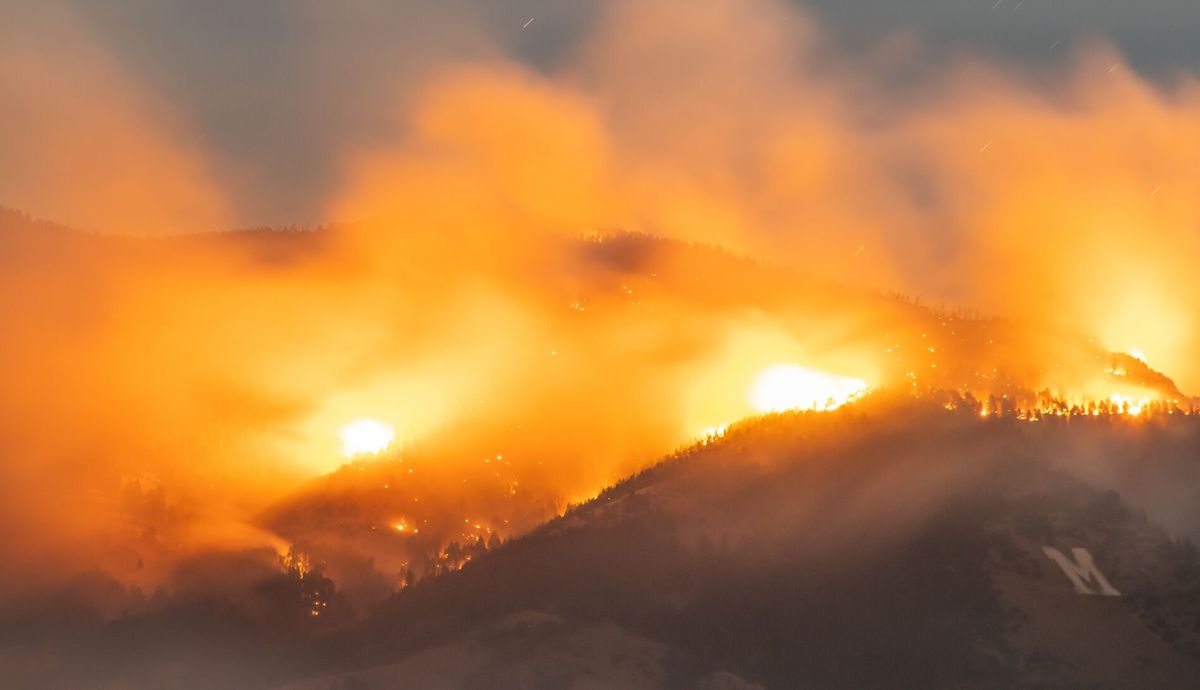
Forest fires in the West are making their presence known by turning skies red, threatening communities and creating unbreathable air in Oregon, Washington, California and Montana. Photos posted on social media and shown in the news depict small towns entirely burned and skies painted an apocalyptic red as particles from the fire reflect red wavelengths of light. This fire season is shaping up to be one of the most destructive and menacing seasons in recent history, largely because climate change has lengthened the dry, hot seasons. Poor forest management also allows fuel, such as undergrowth, to dry out. Coupled with the rising temperatures, this brush makes fires start easily.
Montana is no stranger to fire season. One fire that stunned the state is the Bridger Foothills Fire, which began on Friday, Sept. 4.
The Bridger Foothills Fire began at approximately 3:15 p.m., about 2 1/2 miles up the Bridger Foothills Trail.
By Friday night, the fire was estimated to have increased to about 80 acres. All recreationalists were evacuated from the foothills.
----
By early Saturday, Sept. 5, the fire had grown to 400 acres. Local firefighting crews, including the U.S. Forest Service and volunteer crews attempted to get the fire under control using smokejumpers, air tankers that dropped fire retardant and helicopters that dropped buckets of water.
These efforts were simply not enough to contain the blaze due to warm weather conditions, low humidity and high winds. Residents of Jackson Valley, Kelly Canyon and Bridger Canyon were asked to evacuate, and the Federal Emergency Management Agency (FEMA) approved a Fire Management Assistance Grant. Today, FEMA authorized federal funding to cover 75 percent of the state’s firefighting costs.
Later in the day, Skunk Creek Road was also placed under an evacuation warning. A Type 1 Incident Management Team, which specializes in the coordination and management of personnel responding to large, complex incidents, such as forest fires, was ordered by Gallatin County Fire teams. The first reported injury occurred when a firefighter was struck by a rolling rock on Saturday afternoon. Three other firefighters deployed fire shelters - a safety device used as a last resort when fires become inescapable - in the midst of their work. Fire shelters use heat-reflecting materials to absorb cool air and hopefully keep high temperature flames at bay until crews can be rescued. They were later treated at Bozeman Health Deaconess Hospital for heat exhaustion and smoke inhalation. All four firefighters were allowed to return home after treatment.
Saturday also brought news that several structures had burned on Friday and Saturday, although no official count has yet to be conducted. In the interest of safety, firefighters were ordered to protect structures. The American Red Cross set up a shelter at Christ the King Lutheran Church for evacuating residents, and the Gallatin Valley Food Bank provided food to displaced residents.
----
Today, a more accurate map of the fire was created, and the actual acreage of the fire was determined to be 7,100 - 8,000 acres. Fire activity had slowed enough to allow firefighters to construct handlines, assess structure damage and continue to protect structures. It was announced, in a press release, that the Type 1 Incident Management team would assume command on Monday, Sept. 7 at 10:00 a.m., and that residents of the canyon would be allowed to return home briefly to gather essential items and relocate livestock and pets.
----
The new week brought rain and cooler temperatures, slowing the fire and allowing fire crews to continue to work toward damage mitigation and fire containment. The slowing of the fire also allowed the Gallatin County Sheriff’s Office to assess structural damage in order to report to residents the state of their homes.
Jared Kaplan, a resident of the Jackson Creek area of Bridger Canyon, witnessed the fire crawling across a hillside as he and other evacuees crept down Jackson Creek Rd behind 450 head of cattle.
By the evening of Monday, Sept. 7, Kaplan found himself at the center of a massive coordination effort to connect victims with local relief resources, dubbed Neighbors in Need. Assisting the Southwest Montana Community Organization After Disaster (COAD), Kaplan helped fill the Gallatin County Fairgrounds’ empty arena with donated food, clothing, hygiene necessities, school supplies and shelter opportunities from local residents, organizations and businesses.
“It’s humbling,” said Kevin Larsen, an operations manager at COAD, in regards to the Neighbors in Need event. “...here we are… connecting people to the resources they need. It says a lot about our community.” Relief efforts continue to help serve those who have suffered from the fire.
---
Tuesday continued with cooler temperatures and minimal fire activity. However, the fire was still zero percent contained, according to Operations Section Chief Rob Powell at Tuesday’s virtual public fire information meeting. He said that crews were dedicated to line construction toward Bridger Bowl in the interest of containment. It was also announced at Tuesday’s meeting that a preliminary count indicated that 28 residences and several smaller buildings had burned.
“It was a little eerie,” Kaplan said. “I thought, ‘Am I gonna have to run over all these cows?’” Fortunately for Kaplan and his fellow Jackson Creek residents, the fire never pushed them to such drastic measures. Kaplan worked as a paramedic for 15 years in California before moving to the Bozeman area and has experienced many fires. However, this was his first experience on the civilian side of the struggle.
Immediately preceding the evacuation, Kaplan’s career as a first responder made him a sought-after asset in the informational limbo. Many families wanted to know if their homes still existed and what was to come next in the process of disaster relief. Kaplan initially stepped in as a voice to comfort those who suffered great losses, receiving calls at all hours of the day.
Kaplan and his family returned to their home on Sunday, Sept. 6. The property, including another house into which his parents will be moving in three weeks, did not suffer any damage thanks to the work of firefighters. Kaplan continued his efforts to help those affected by the fire.
----
By now,, there were 15 active fires within Montana, ranging in size between 100 acres to 10,000 acres. The preliminary findings from a Sept. 11 press release suggest that, despite the clear, cloudless day, the Bridger Foothills Fire resulted from a hold-over lightning strike from a storm occurring a few days prior. “It’s very common for fires to appear several days to weeks after a lightning storm has passed through,” District Ranger Corey Lewellen said.
---
A Type 2 Incident Management team took over for the Type 1 team and continued to make progress on containment.
“The biggest step now is to house [victims of the fire]. That’s what’s coming to a halt. We’re looking for housing [for] up to a year or two, and Bozeman’s so packed right now there is no housing available,” Kaplan said. While many donors have provided temporary housing, only a few have been able to provide long term solutions.
The local chapter of the Human Resource Development Council (HRDC) found local community members willing to loan entire apartments and trailers to those affected by the fire, though they have yet to reach the demand of 28 displaced households.
--
Bridger Canyon road has been opened for residents only.
---
As of the day of publication, the fire was 83% contained, and certain area residents have been allowed to return home permanently. The National Forest Service predicts that the fire will be totally contained by Wednesday, Sept. 30.



Comments ()