
Celebrating the right to read with Banned Book Week
Book banning is defined by Encyclopedia Britannica as the practice of prohibiting or restricting the availability of certain books by governments, religious organizations, communities, businesses or even private individuals. According to some members of the Bozeman community, banning books gets rid of access to diverse perspectives and limits freedom of speech.
The American Library Association (ALA) coined this year's Banned Book Week theme as “Freed Between the Lines,” with the goal of advocating for individual freedoms and fighting against censorship. This year, Banned Book Week began on Sept. 22 and runs through Sept. 28.
According to its website, the ALA is a nonprofit organization and the largest and oldest library association in the world. Banned Book Week was established in 1982 by the ALA as a response to the sudden surge in the number of challenged books in libraries, bookstores and schools in hopes of drawing attention to the harm of censorship.
Since then, the ALA has compiled a list of books currently under scrutiny from across the country in an effort to show the public what books are in contention.
“From my perspective, I think Banned Book Week is popular because people don't always realize what a banned book is,” said Maris Fessenden, an employee at Country Bookshelf. “When they hear that their favorite title — or something like the Bible — is on the list of banned books, they're surprised, shocked, curious about why and what that means.”
Fessenden explained that a challenged book is a text that anyone has objected to on grounds of inappropriate content — such as sexually explicit content or offensive language — but is generally able to stay in the library, school, bookstore, etcetera. However, a banned book is completely removed from its location and can not be accessed in a library. These challenges and bans are made on a local scale, according to the First Amendment Museum.
Star Bradley, instruction librarian and assistant professor, also shed light on the complexities of banned books. “Books can get banned years and years after they've been published. It's not when the book comes out that it gets banned. It's when somebody notices there's something in it that they don't like that it gets banned or challenged,” she said. Essentially, book bans often arise from a large push by people to ban a single book or a group of them.
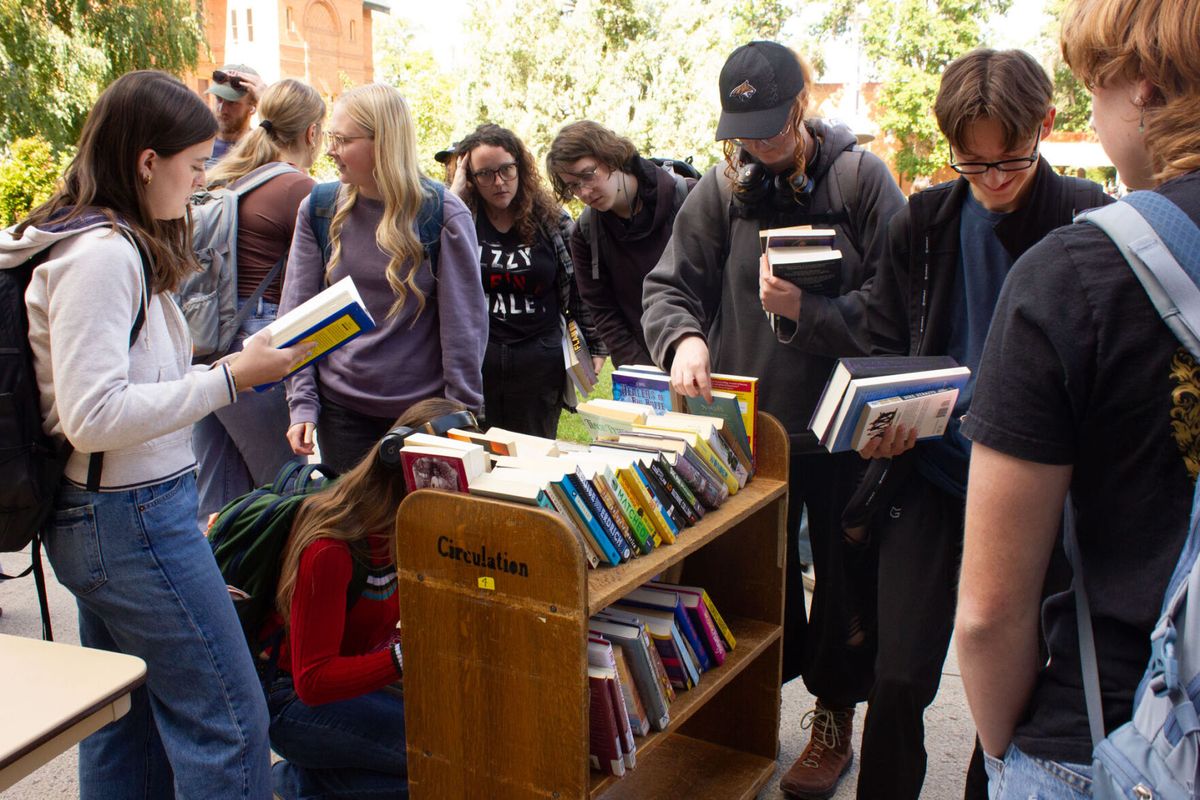
“Bans and challenges aren't coming from libraries, they're coming from individuals who are bringing them to the library. Libraries are not wholesale banning books,” Bradley said. According to Bradley, libraries want people to read all forms of literature, so banning books is in opposition to that goal. That’s why the MSU Library hosts a yearly giveaway for Banned Book Week.
On Sept. 23, the MSU Library hosted its third annual free book giveaway event. The event was sponsored by the Friends of MSU Library Board, an organization that promotes library events on campus and fosters support in the community. Trinity Simmons, a sophomore at the book giveaway, noticed the sheer volume of books that are banned across the country as she was waiting for the giveaway to start. “I don't believe in banning books at all, in any form. It's really disappointing to see freedom of expression and freedom of speech be limited so severely. People look to books for representation,” she said.
Like the MSU Library, Country Bookshelf also put together a book display in their store in preparation for Banned Book Week. Fessenden explained why certain books are banned. “This one was claimed to be anti-white and anti-Catholic. It is a Young Adult book that I love called The Morrow Thieves by Indigenous author Cherie Dimaline. So to me, that reveals a sort of lack of sincerity around why people are challenging books and also reveals why these books are so important,” Fessenden said.
“At least what I've noticed is that banned books go against popular religious views, it's things that go against popular political views, and it's things that go against the mainstream type of sexuality and nuclear family. It's glaringly obvious that it's excluding what's seen as abnormal, which to thousands and thousands of kids every day is their normal, everyday experience,” Christiaens said. She’s also noticed a contrast between the books that are banned and popular cultural and social norms that prevail.
“Unfortunately, most of the books that show up on the American Library Association Top Ten Banned and Challenge List are from diverse perspectives,” Bradley said. She continued by explaining that many of them are LGBTQIA+ books. “A lot of people don't want their children to read these types of books, which I think is unfortunate, because as the parent of an [LGBTQIA+] child, I don't want my kid to go to the library and not feel represented. I think it's important that everybody be able to go into a library and feel represented from all aspects of the spectrum,” she said.
Hannah Christiaens, a senior at MSU, spoke about her experience with educators that simply avoiding teaching certain books during her schooling in rural Montana, rather than banning them outright.
“Nobody really banned books at my school, but that was just because the teachers always played it super safe. The same teacher that had been teaching me had already been in that district for 15 years, so she was not gonna switch up at all. But it was definitely very clear in the library and just different things like what books were okay and what books weren't,” she said.
The ALA found in its data from 2023 that titles representing the voices and lived experiences of LGBTQIA+ and BIPOC individuals made up 47 percent of those targeted in censorship. However, books like “Harry Potter” and “The Bridge to Terabithia” have also been banned for occultism or satanism while books like “The Holy Bible” have been banned for its violent depictions of sex.
Whether or not people can agree on a reason to ban something, some feel that banning anything is restrictive. “I mean, banning things in general gets rid of access,” Christiaens said.
Christiaens said she advocates for people to consider what reading about LGBTQIA+ people in particular actually means. “What needs to be realized is that you're not exposing children to anything new, and a lot of the time, you're just hindering them, especially people who are afraid to read [LGBTQIA+] texts. You're not going to turn kids gay by having them read [LGBTQIA+] texts. You're just going to educate them. If a kid is gay, a kid is gay. And if a kid is not gay, they're not going to turn gay because they read a book about gay people,” she said.
Bradly also explained that if a parent doesn’t want their child to read a certain book in an academic setting, they can simply tell the school they don’t want their kid to read the book. “I was an elementary school librarian for a few years, and we had that happen. Parents would come in and say, I don't want my kid reading graphic novels. Okay, your kid's not allowed to read graphic novels,” Bradley said.
Ultimately, allowing agency over what people choose to read is a value many hold close to their hearts; this is what Banned Books Week is all about. “Speaking of [the U.S.], I know we're so proud of our freedom and our free speech and right to protest and all these things that we have — just all of this autonomy — and then we decide to ban books, and it just is so juxtaposing to me. I don't understand the benefit of banning books,” MSU senior Kiersten Smith said.

Comments ()