
MSU’s American Indian Hall: A long history and a bright future
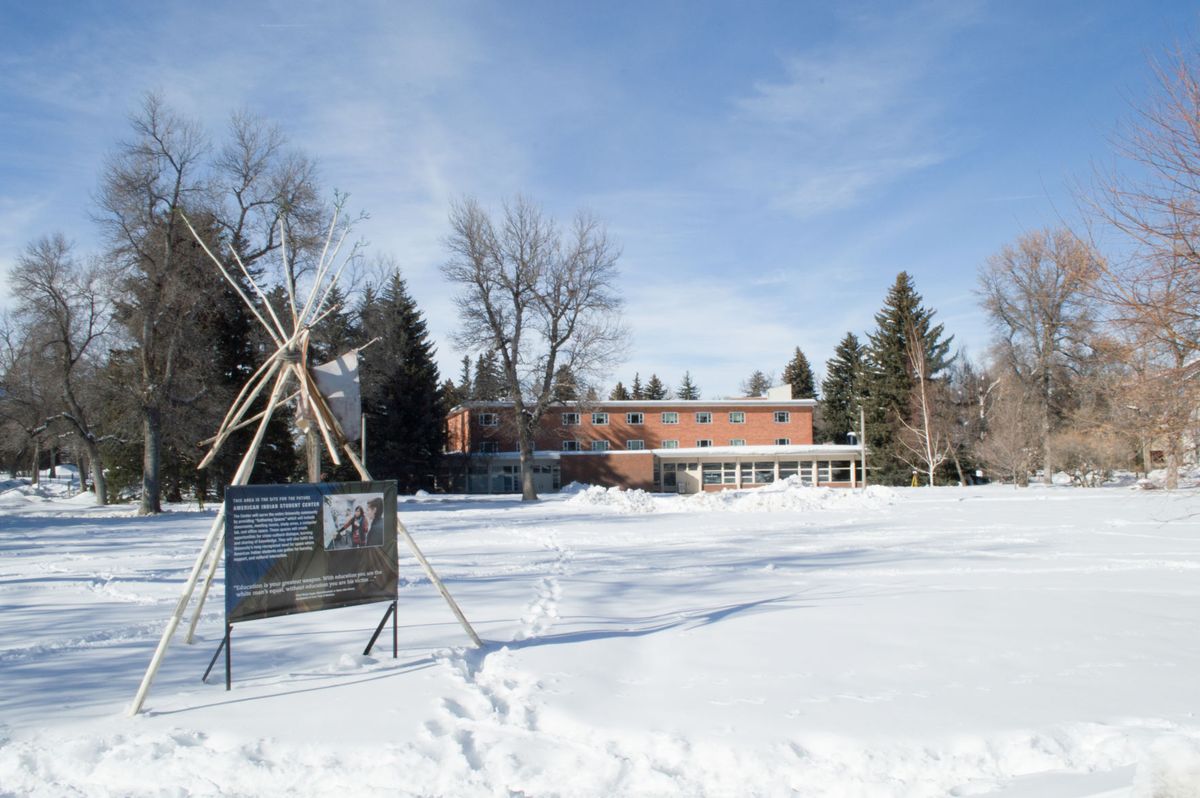
Starting this spring, MSU will begin construction on its highly-anticipated American Indian Hall after nearly 15 years of preparation and patience. This hall will be the new location for MSU’s Department of Native American Studies, and will also serve as a tribute to and celebration of Montana’s American Indian history and culture. According to Department of Native American Studies member Walter Fleming, Ph.D., “The campus of MSU stands on traditional tribal homelands. In a real way, the American Indian Hall represents a homecoming for MSU’s nearly 800 American Indian students, and demonstrates MSU’s commitment to recruit, retain and graduate the first citizens of the state of Montana.”
A long history
The original idea for an American Indian hall at MSU was proposed in late 2004 when Dennis Sun Rhodes, an architecture graduate from MSU and a member of the Northern Arapaho Tribe from Ethete, Wyoming, alongside Montana artist Jim Dolan, first proposed the idea of an entire hall dedicated to American Indians to former MSU President Geoff Gamble. In 2005, Sun Rhodes created the first draft of a building design for the hall, incorporating a feather-based design. Fleming noted that, following site and design approval for the American Indian Hall, in the spring of 2005, “nearly 300 MSU faculty, staff, students, friends, representatives from the Bozeman City government and children from the MSU Child Development Center gathered at the site where eight tipis were erected; seven put up by tribal members from the seven reservations in the State of Montana and one tipi, owned by the Department of Native American Studies, to represent the building that would eventually be built on the site. More importantly,” Fleming went on to add, “representatives from the twelve tribes of the site, in accordance with their practices, blessed the site.”
A tipi sculpture, created by Dolan, has stood there since to serve as a reminder of MSU’s intention to create the American Indian Hall. By June of 2006, plans for the hall were well underway, and ThinkOne Architects of Bozeman was selected as a consulting firm to partner with Sun Rhodes’ AmerINDIAN firm. Lack of funding slowed the progress of construction in the following years, but in 2010, following her induction as MSU’s president, Waded Cruzado “reestablished a building committee” and added the hall to “the long range plan, and ThinkOne was re-engaged to begin finalizing construction planning,” Fleming said regarding the history of the hall.
Current progress
On Oct. 8, 2018, President Cruzado announced that a $12 million pledge had been given toward the American Indian Hall by the Kendeda Fund. This private company is a grant-making foundation “with a long history of supporting conservation and community-led projects in Montana,” according to Carol Schmidt with MSU News Service. The hall itself was projected to cost $20 million, and MSU has been waiting for the necessary funding to move forward with the project for several years. The donation of the Kendeda Fund was the first step in moving forward, and it jump-started a series of donations which ultimately made it possible for construction to begin this spring.
Upon announcing the Kendeda Fund donation on Indigenous Peoples’ Day, President Cruzado claimed that, “This very land on which we stand today is aboriginal land, once a cherished home to several American Indian tribes. This building will honor our American Indian people and their descendants, welcoming them back to their home with a building that reflects their culture with beauty, honor and grace.” Funding for the hall was officially secured in December following donations from Jim and Chris Scott of Billings and the Terry and Patt Payne family of Missoula, both of whom gave $1 million toward the building. Additionally, ASMSU has promised to contribute $2 million from student fees toward the project.
An exciting future
As plans for the hall move forward, MSU’s Department of Native American Studies, and all the services related to MSU’s American Indian students, are receiving the recognition and space they have been lacking since the 70s, and the hall will serve a crucial role on MSU’s campus. “We are honored that so many donors believed in this project and provided financial assistance to see it through,” Fleming noted. “We are especially grateful to the Associated Students of Montana State University (ASMSU) who joined the Kendeda Fund, the Scott Family and the Payne family in support of the building.”
Since this fall, much has been underway to propel the construction of the hall. A ground blessing ceremony is set for March 29 at the building’s location on the eastern edge of MSU’s Malone Centennial Mall at 3 p.m. During this time, MSU professor emeritus of Native American studies and Cheyenne prayer woman Henrietta Mann will offer a prayer of thanksgiving and blessing. Additionally, Tony Incashola, Salish spiritual leader and a member of the MSU Council of Elders, will lead a traditional smudging ceremony, a process in which sage is burned to purify and cleanse an area. A round dance will follow, and this ceremony will be the official opening to the university’s 44th Annual American Indian Council Powwow. In addition, the ground blessing will launch construction of the hall. According to Fleming, “it is anticipated that actual construction will begin shortly thereafter with geothermal well testing,” and that building will “continue on a vigorous schedule aimed at completion sometime before the beginning of Fall Semester, 2021.” This ceremony is free and open to the public, but those wishing to attend are asked to RSVP at www.montana.edu/calendar/events/29055.
Currently, the American Indian Student Center is located in the basement of Willson Hall, where it has been since the building’s construction in 1974. According to MSU News Service, there were only 25 students who identified as Native American at the time, whereas MSU currently has 776 Native American students enrolled — and that number will only continue to increase.
Once the American Indian Hall is finally constructed, MSU’s growing American Indian student population will be able to move to a space that better accommodates their needs and highlights their important role on campus. According to Fleming, “The American Indian Hall will house support services for Native students attending MSU.” One such service, The American Indian and Alaska Native Student Support Services, a center within the Department of Native American Studies, “provides services to aid in the retention of students.” The need for more space for these departments is clear, the American Indian Hall will allow these departments to expand their abilities to serve their students by providing them with the space and resources necessary to do so. In addition to these services, Fleming stated that “MSU’s Senior Diversity and Inclusion Office will likewise be located there,” along with “three classrooms to help advance MSU’s academic mission.” For more information on MSU’s American Indian Hall, visit www.montana.edu/aih/.


Comments ()